


IT SHOULD COME AS NO SUPRISE that the residents of this New Canaan home, with its Axel Vervoordt influence of austere elegance, stark contrast and organic textures, grew up with the Old World style in northern Europe. What is surprising is that neither Hans Neleman, a Dutch-born, SoHo-based photographer and founder of stock photography provider WIN-Initiative, and his wife Tessa Neleman-Pimontel, a Belgian-born designer and stylist, ever formally studied interior design. Each attended art school, Neleman for photography and Pimontel for fashion, and both have an affinity for creating warm, inviting spaces. The furnishings in their four-bedroom home, which they share with their three children, age 6 to 10, have been picked out of demolition depots, uncovered at flea markets, and even repurposed from hardware stores in Mexico. “It’s nice to find things that already have life to them and are unique,” says Pimontel, whose design consultancy Echo and Mercer references her Echo Hill residence and her Mercer Street office. “They make a house feel like a home.”
Neleman first found the property as a bachelor in the early 1990s. Seeking a retreat from his SoHo loft, he and a real estate agent got lost looking for upstate New York and somehow ended up in Connecticut. “It was like a movie set!” Neleman says of New Canaan. “I said to the agent, ‘Hey, this is really nice,’ and she said, ‘Oh, this isn’t your bag,’” he recalls, laughing. “I said, ‘Well, I’ll decide that.’”
Neleman bought the 1937 cottage, with its ’70s interior, separate artist studio and pool, and tore out the walls to create an open, loft-like space. Many years—and three children later—the couple realized they needed to expand. What started as a rather innocent plan to connect the 700-square-foot studio to the 1,700-square-foot house became a renovation that added another 1,000 square feet. “Well, we did keep the fireplace,” she says.
Both Neleman and Pimontel have an affinity for
creating warm, inviting spaces.
Pimontel was influenced by modern hotel design and by European principles of symmetry, especially the harmony she saw in multi-residence buildings such as monasteries and, even, orphanages. She drew inspiration from the Madeline books, by part-Belgian author Ludwig Bemelmans, which all begin with a description of the character’s boarding school: “In an old house in Paris that was covered in vines, lived twelve little girls in two straight lines.” Accordingly, Pimontel planned the house with children’s rooms on one side, the master—which had been the artist’s studio—and the living areas on the other. A long hallway flows through the middle and opens up to the garden. “It’s an architectural solution,” she says.
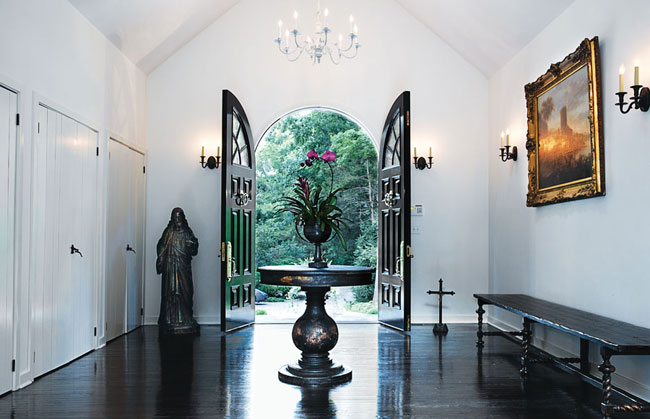
It was on a family vacation that the couple realized the same cozy aesthetic they grew up with and loved—dark wood, oversize furniture, gilded and cracked picture frames—could be found on this side of the Atlantic. Driving through San Miguel de Allende, Mexico, they went into a hardware store and bought the wood counter and a massive cabinet used for storing tools. Both pieces—which were about to be chucked—are now in the kitchen; white dishes sit on the open shelves for easy access. Pimontel designed the long bench in the entry hall—she sketched it while standing in a shop in San Miguel de Allende. It has the same legs as the dining chairs, which she also designed. Six chandeliers are evenly spaced down the hall; two of them hang in the entry, where a heavy table with a shapely base serves as a centerpiece. “It’s deliberate that the hall is empty,” she says. “Sometimes the negative space is stronger than filling it.”
“It’s deliberate that the hall is empty,” says Pimontel.
“Sometimes the negative space is stronger than filling it.”
The family isn’t fussy about delegating certain areas of the house for particular functions, and the place buzzes with projects and play. While Neleman is experimenting with light behind his camera, children Eden, Hudson and Avalon, who design their own bedrooms in constantly evolving styles, may be at the dining table with school projects. They often transform the hall, their playroom, into a pretend marketplace or bowling alley, and throw the doors open to the garden. In the spacious master bedroom, Pimontel may be sketching at her workspace behind the bed, or upstairs in a small loft, sewing pillows, draping clothing or reupholstering some grand chairs in modest linen. “If you’re a designer at heart,” she says, “you can design anything.”
