


Fifty years ago, the IPX Corporation’s concept for the North Hollow community in Northwest Woods was just one of many subdivision requests being floated in the Town of East Hampton. But the developer’s proposal for a swath of land hugging the coastline of Gardiners Bay raised an unusual amount of local ire. When IPX submitted the 40-acre project to the public in 1972, the Town Planning Board deemed the street layout “unimaginative,” and the following year, when the North Hollow application was expanded to 64 acres, a newly formed watchdog group issued a counter-scheme to put pressure on investors to cluster houses and preserve local habitat.
IPX ultimately developed the land with few substantive changes to its original vision. To call the completed subdivision unimaginative, however, would be to overlook an important innovation: IPX filled North Hollow’s one-acre lots with contemporary houses by progressive architects such as Norman Jaffe and Harry Bates. The home featured on these pages, designed by Bates in 1981, is now occupied by George Doomany and Norman Goldblatt, former New Yorkers who split their time between East Hampton and Palm Springs.

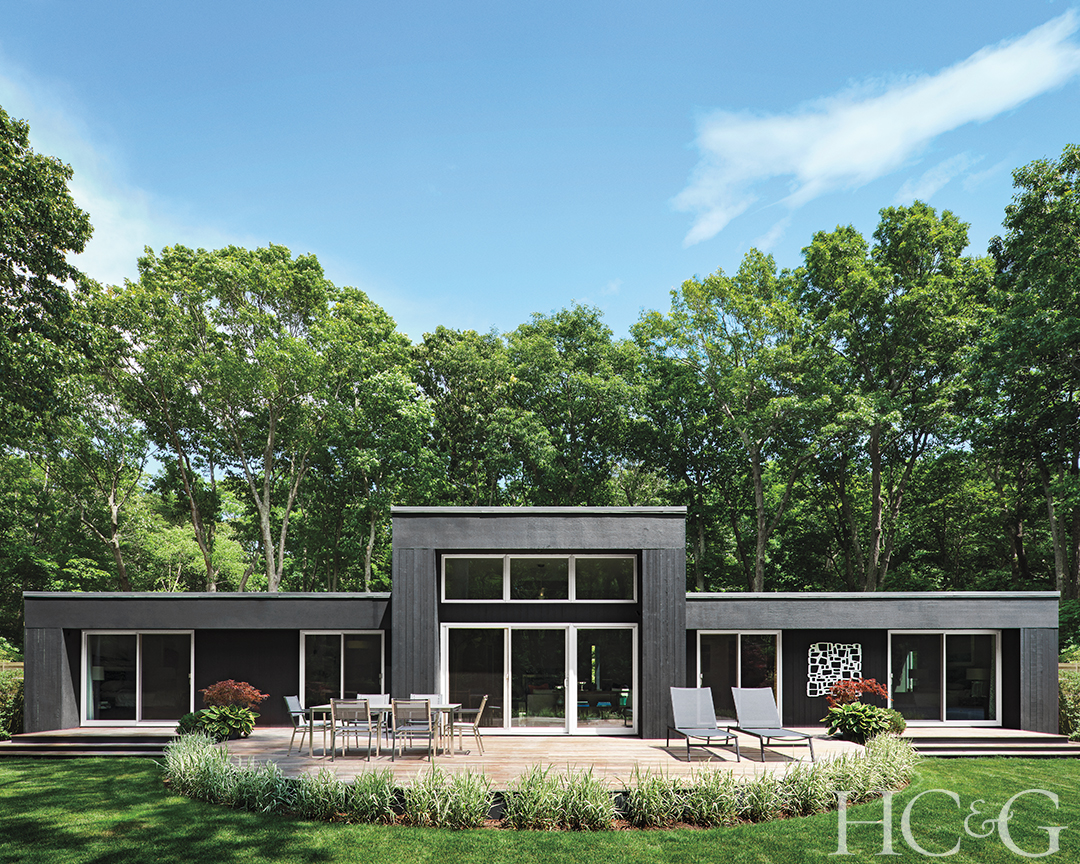
The grounds have been maintained by a series of garden-loving owners since the house was built. The exterior siding is painted Benjamin Moore’s Cheating Heart.
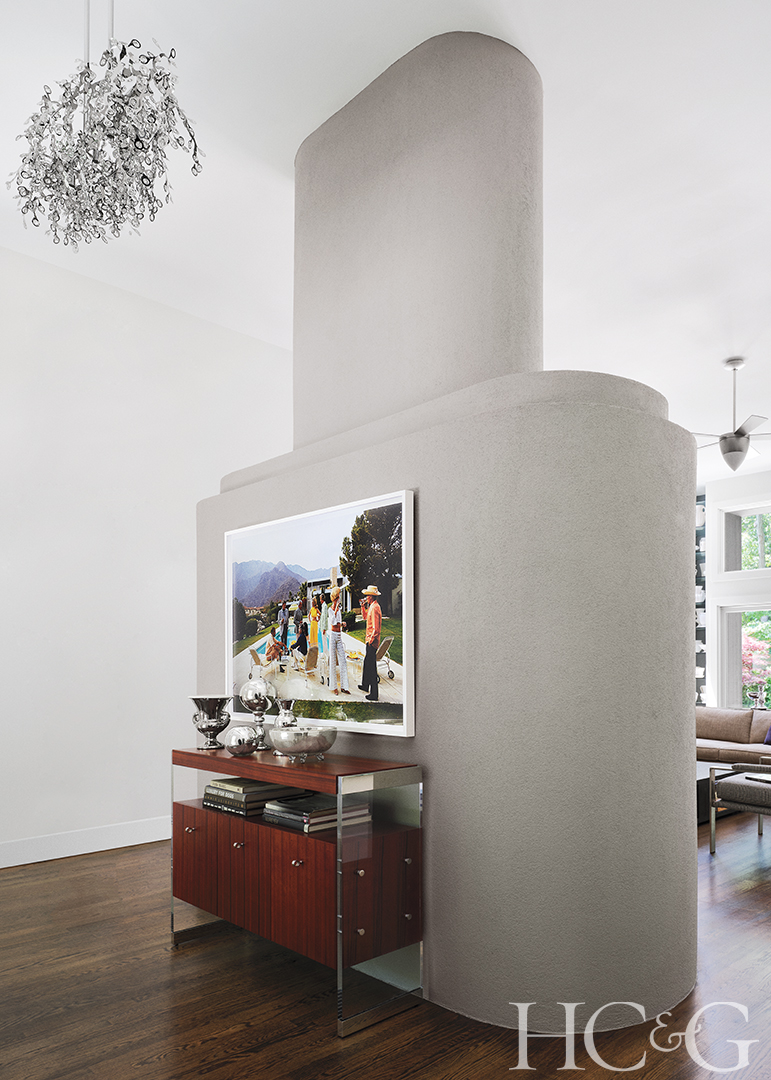
A Slim Aarons photograph hangs on the freestanding chimney in the entry. The console is from Mitchell Gold + Bob Williams.

In the living room, vintage Milo Baughman armchairs from Thayer Coggin are upholstered in Ralph Lauren’s Wessex Glen Plaid.

A 1970s Curtis Jeré sculpture hangs behind a Saarinen Tulip table in the dining room.
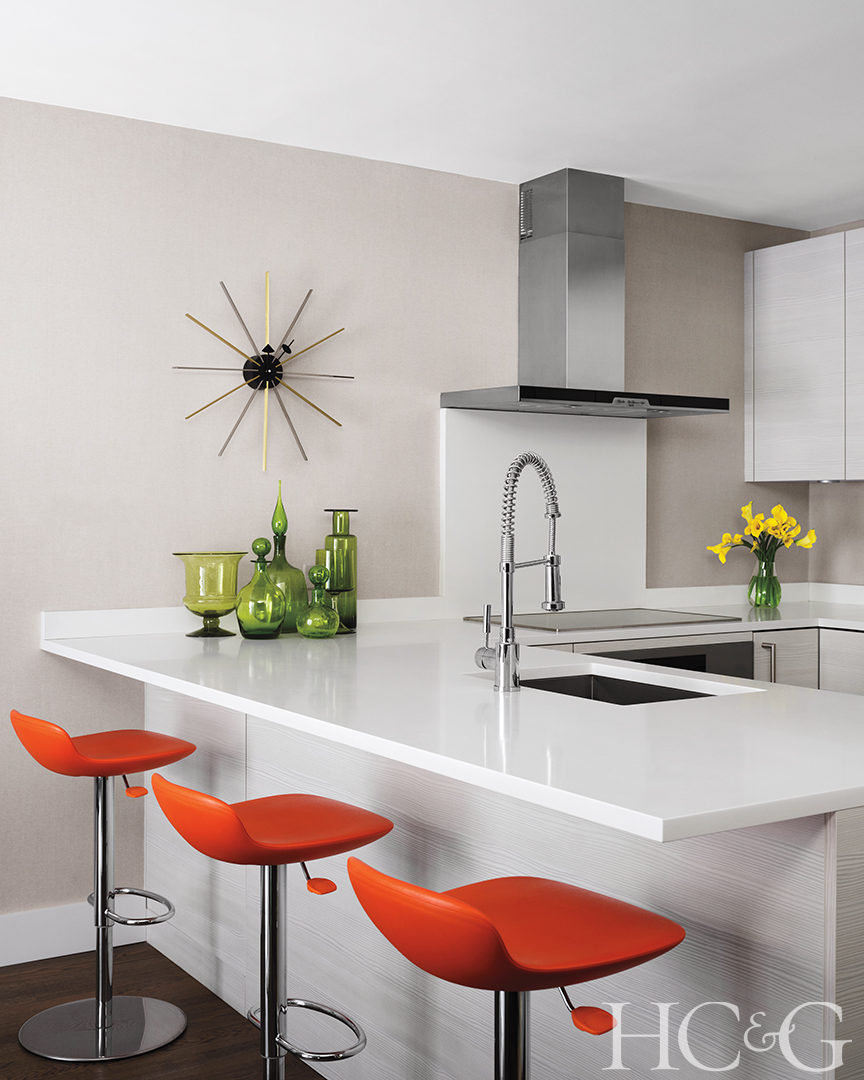
Leo barstools from Room & Board line a Caesarstone countertop in the kitchen; the range and hood are from Miele.
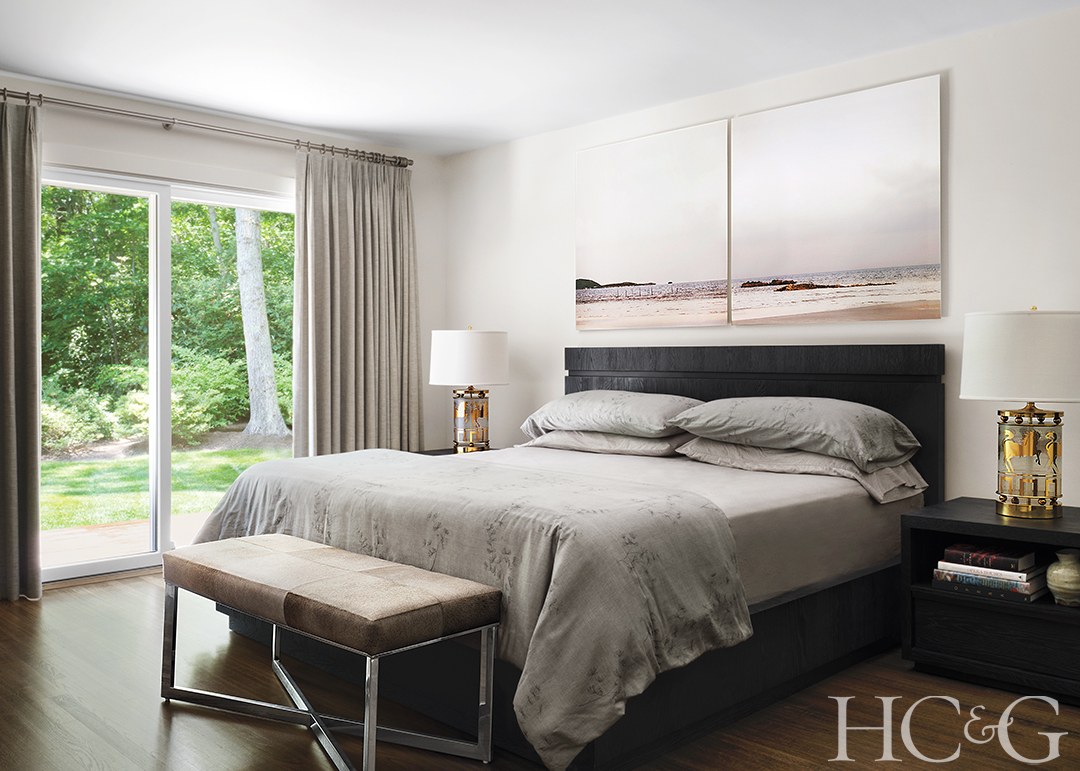
In the primary bedroom, Calvin Klein bedding covers a bed from RH Modern.
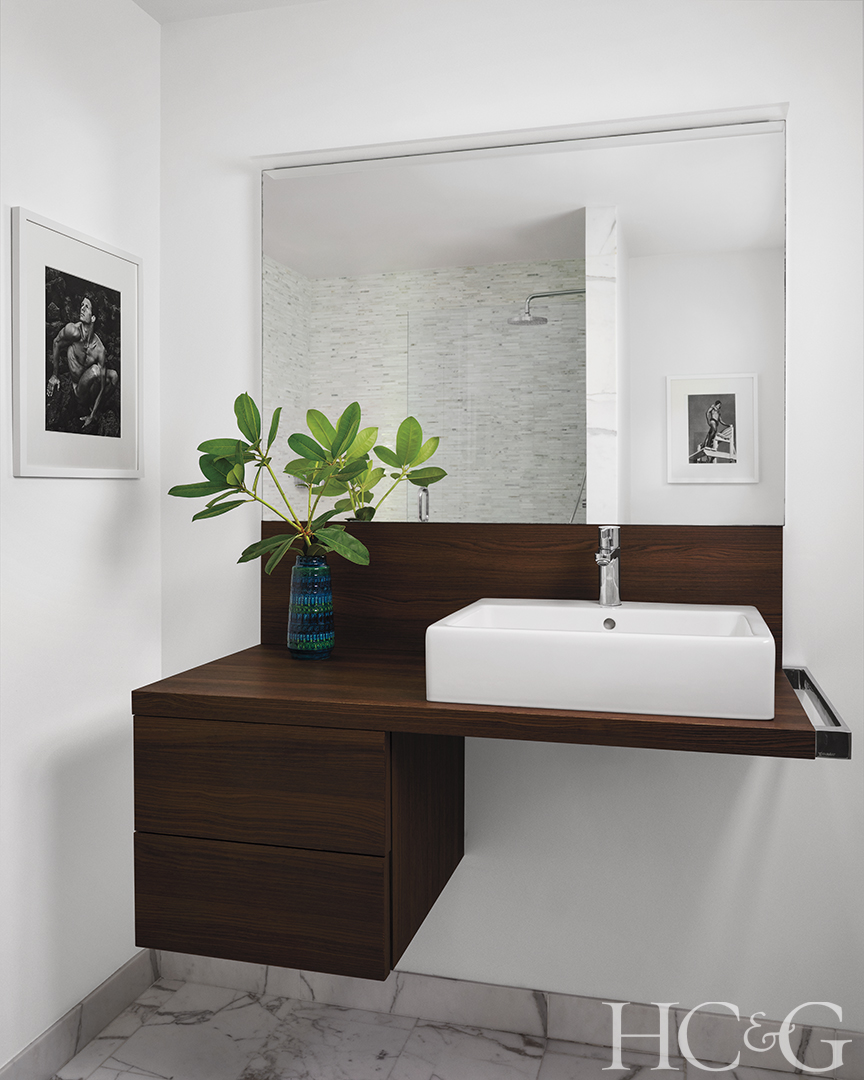
A Bruce Weber photo of Jeff Aquilon hangs above a Duravit vanity in the primary bath.
A semicircular deck counterbalances the home’s pronounced linearity. The dining table and chairs are from Barlow Tyrie.
In 1980, shortly after finishing a pyramidal house for himself on one of IPX’s own lots nearby, Bates permanently moved his studio from New York to Southampton. But the 1981 design on North Hollow’s namesake drive bears little resemblance to his own residence. The three-bedroom structure is almost classical in its bearing, with a double-height central volume flanked symmetrically by two shorter wings. Bates Masi + Architects’ Paul Masi says he “wouldn’t be surprised” that his mentor and business partner had veered a bit from boisterous modernism. “Harry was sort of dogmatic about working with a simple palette of materials and focusing on experience, although he would have dabbled on the edge of something else if the client had wanted it. He’s never had the ego that you expect from architects. And he would have rather stayed home than do the same thing over and over again, too.”
In addition to expressing Bates’s approach to his craft, the house eventually became a regal backdrop for specimen plants. Original owners Andre Dupuis and Kenneth Kroft were both avid gardeners, and after Kroft’s death from AIDS-related pneumonia in 1989, Dupuis continued improving the grounds with the help of his live-in friend David Murbach, a horticulturist who selected the Rockefeller Center Christmas tree, among his other head-gardener duties, between 1984 and 2010. All three men were particularly devoted to shrubs and small trees, and from certain outdoor perspectives the house appears to occupy a bowl of rhododendrons.
Goldblatt, a retired fashion executive, and Doomany, who works in private equity, bought the house in 2017, having recently shifted their taste toward mid-20th-century modernism after 40 years together. Bates’s design appealed for its ranch-style living, and Doomany notes that the pair’s Boris Gertzen–developed home in Palm Springs also boasts a cruciform plan and a single level. After Dupuis’s death in 2012, a second owner “had done a beautiful job of renovating the kitchen and baths,” Doomany adds. In turn, he and Goldblatt focused on exterior repairs and replacements, as well as updating interior flour- ishes like closet doors and baseboard moldings. Doomany has additionally invested sweat equity in the arboretum-like acre that activists had once feared would not be possible when North Hollow was developed. “I’ve been a serious gardener for 25 years and am so gratified that we have been able to restore the landscape like we’ve restored the house,” he says. “We feel like we inherited a legacy.”
